
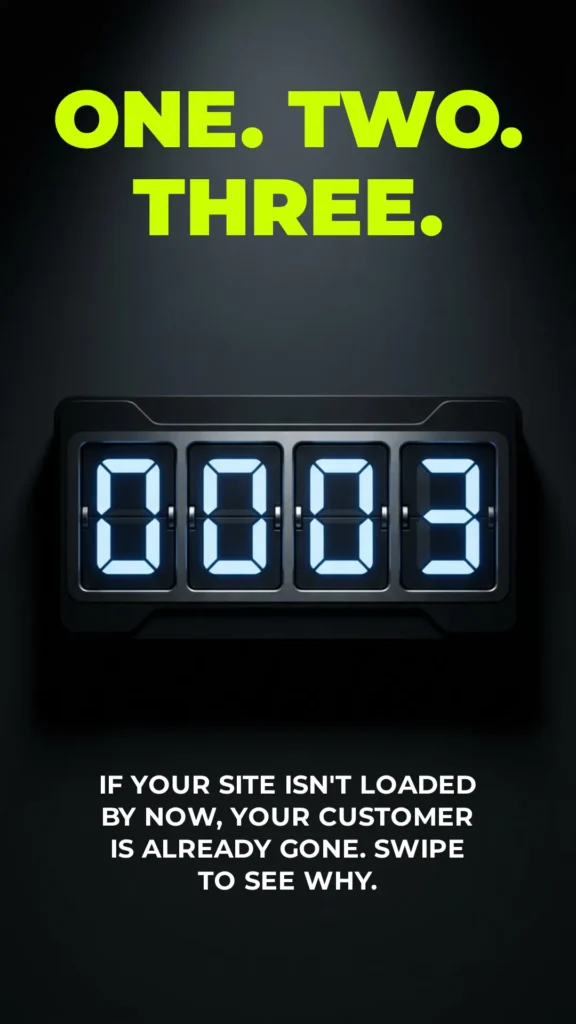
Website speed is not a technical detail. It is the difference between a customer and a bounce.
Count to three.
One. Two. Three.
That is it. That is the window.
If your website has not loaded by the time someone finishes counting to three, there is a good chance they are already gone. Back button. Closed tab. On to the next result.
They did not read your carefully written copy. They did not see your portfolio. They did not find out what makes you different. They saw a blank screen, or a spinning wheel, or a half-loaded page and made a decision.
The decision was simple. This is not worth waiting for.
Website Speed Expectations
We have been trained to expect instant results.
Google loads in a fraction of a second. Amazon pages appear almost immediately. Social media feeds refresh instantly. Streaming services start playing without delay.
These experiences have reset expectations. People do not think about load times until something feels slow. Then they notice. And they leave.
The research is consistent. For every additional second a page takes to load, conversion rates drop. One study found that pages loading in 1 second had conversion rates three times higher than pages loading in 5 seconds.
Three times higher. Simply by being faster.
What Is Actually Happening
When someone clicks on your website, a race begins.
Their browser sends a request to your server. Your server processes the request and sends back files such as HTML, CSS, JavaScript, images and fonts. Their browser receives those files and assembles them into a page. Each step takes time.
On a well-built website, this happens in under two seconds. The page appears. The visitor starts reading.
On a poorly built website, it takes much longer. The server is slow. The files are too large. The code is inefficient. Images are not optimised. Third-party scripts delay the page from appearing.
The visitor watches a blank screen. Or a broken layout. Or a loading spinner that keeps spinning.
Then they leave.
Why Website Speed Drops Over Time
Most slow websites did not start that way. They became slow over time.
Unoptimised images
Someone uploads a 4MB photo straight from their camera. It looks fine but takes seconds to load, especially on mobile. Multiply that across the page.
Plugin bloat
Every plugin adds code. Code takes time to load. A site that started with five plugins now has thirty.
Third-party scripts
Analytics, chat widgets, social embeds and tracking pixels all add requests to external servers. If those servers are slow, your site is slow.
Poor hosting
Cheap hosting means shared resources. When the server is busy, your site waits.
No caching
Without caching, every visit rebuilds the page from scratch instead of serving a ready-made version.
Inefficient code
Themes and frameworks load features you do not use. Extra CSS and JavaScript slow everything down.
None of this is obvious when you view your own site. It loads eventually, so it feels fine. But your visitors do not wait the way you do.
What Fast Actually Looks Like
A properly optimised website loads in under 2 seconds, often faster.
Here is what makes that possible:
- Optimised images
Compressed and properly sized. A 2MB image becomes 150KB without losing quality. - Efficient code
Only what is needed. No unnecessary bloat. - Smart caching
Pages are pre-built and ready to load instantly. - Quality hosting
Fast response times and enough resources to handle traffic. - Lazy loading
Only visible content loads first. Everything else loads as needed. - Minimal third-party scripts
Only essential tools, loaded without slowing the page.
The result is simple. Click, and the site is there. No waiting. No guessing. No frustration.
The Business Impact
This is not just about user experience. It affects revenue and visibility.
Google uses page speed as a ranking factor. Slow sites are pushed down. Fast sites get a boost, especially on mobile.
Bounce rates increase as load time increases. Every second of delay means more visitors leave before seeing anything.
First impressions happen instantly. A slow website feels outdated and unprofessional.
Conversions drop with delay. Even visitors who stay are less likely to act.
How to Check Your Site Speed
You can test your website using free tools:
- Google PageSpeed Insights – https://pagespeed.web.dev/
- GTmetrix – https://gtmetrix.com/
- WebPageTest – https://www.webpagetest.org/
- Our free audit tool – https://rebellionsystems.com/website-audits#free-audit
These tools show your score and highlight issues. If you are below 80, there is room to improve. Below 50 means you are likely losing visitors.
The details can be technical, but the principle is simple. Faster is better.
The Question
How long does your website take to load?
Not on your office connection. On a phone. On mobile data. In real-world conditions.
If it takes more than 3 seconds, you are losing people before they even see what you offer.
Every second costs you customers. How many seconds is your site costing you?
We build fast websites. Not just acceptable. Genuinely fast. Optimised from the ground up to load in under 2 seconds, so you stop losing visitors before they arrive.
If your current site is costing you customers, let’s fix that.